.png)
Photobook Analysis
Photobook Analysis: Anthony Friedkin: The Gay Essay
Details:
Title: The Gay Essay
Author/s: Friedkin, Anthony; Cox, Julian, with Blake, Nayland (Edited by), with Myles, Eileen (Poem by)
Publisher: Fine Arts Museums of San Francisco; Yale University Press, San Francisco
Published: 2014
Dimensions: 30.58 x 28.24 x 1.37 cm
Pages: 144
Cover Design:
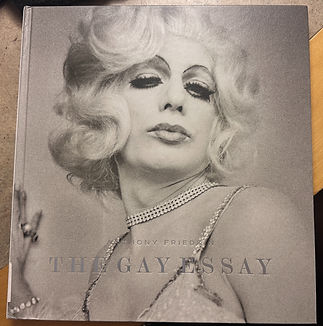
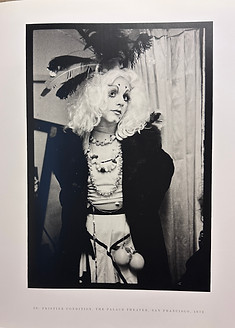
The front cover features striking black-and-white portraits that create a strong sense of presence, closeness, and honesty. The subject on the front, reminiscent of Marilyn Monroe, makes direct eye contact with the viewer, while looking slightly down, which adds both charm and authority. The book title is in silver and subtly embossed, taking a backseat to the subject's gaze. When you look closely, you can notice an Adam’s Apple, a detail that could complicate the initial perception of the subject’s femininity, especially for society in that era. This gradual reveal turns the act of looking into a moment of uncertainty, encouraging viewers to reflect on their own beliefs about gender and identity even before opening the book.
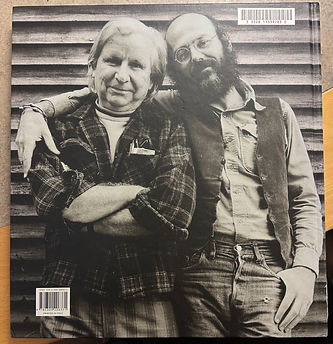
The back cover shows a full-size black-and-white portrait that gives off a vibe of honesty and authenticity with its balanced tones. This time, the photo features two men in a close side hug, maintaining eye contact with the viewer. The image feels confident and straightforward, showcasing their intimacy without any drama or exaggeration. Unlike the flashy glamour of the front cover, this portrait broadens the representation, indicating that the book will explore various aspects of queer identity, ranging from allure and performance to tenderness and everyday connections.
Subject Matter:
Anthony Friedkin’s The Gay Essay, created between 1972 and 1973, is an insider documentary series that captured the queer communities of Los Angeles and San Francisco during a time when they faced significant social oppression.
Photography:
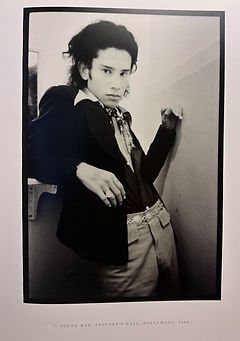
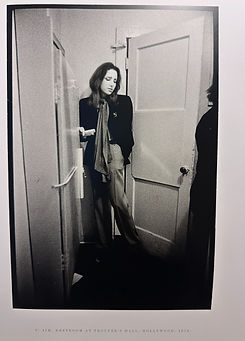
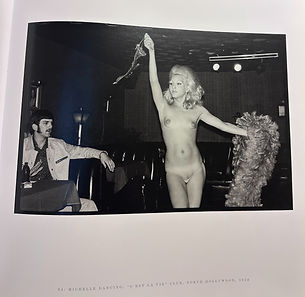
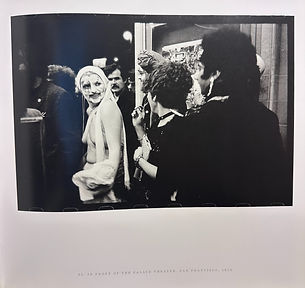
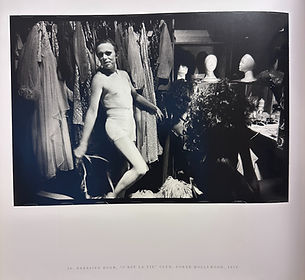
The photography of The Gay Essay highlights the visibility and dignity of queer lives, which was innovative for its time. Friedkin set out to document the gay and lesbian communities in Los Angeles and San Francisco during the early 1970s, showing them as vibrant individuals instead of societal outsiders. His work mixes documentary and portrait styles, focusing on the human aspect. The black-and-white format emphasises form, gesture, and emotion, keeping attention on the people and their relationships. Friedkin’s approach used natural light, thoughtful composition, and a straightforward style that adds to the authenticity of his subjects. Key images include the eye-catching portrait of a drag queen on the cover, showcasing glamour and identity, and the poignant back cover photo of two men embracing, affirming their intimacy. Other important photographs include marches, bars, and personal moments, together forming a vibrant, political, and undeniably human archive.
Page Layout:
The layout of The Gay Essay is straightforward and uncluttered, keeping the focus firmly on the images. Photographs are mostly full-page, allowing the viewer to engage directly with the subjects without distraction.
Text
All images are captioned in small text, ensuring the photographs themselves lead the viewer’s experience. The Gay Essay opens with a foreword, followed by two essays and a poem before the main photographic series. These introductory spreads pair full-bleed photographs on the left-hand pages with text on the right, visually anchoring the pre-series texts. The photographs (plates) are then organized into sections grouped by specific spaces, with the exception of “Portraits” and “Female Impersonators.” After the images, the book includes an exhibition catalog, an afterword by Anthony Friedkin, a selected bibliography, acknowledgments, and a list of contributors. Published by the Fine Arts Museums of San Francisco and Yale University Press, the book carries a distinctly scholarly structure, enriched with extensive contextual and critical writing.
Editing & Sequencing
The editing and organisation of The Gay Essay is purposeful, making it easier for readers to grasp queer life in Los Angeles and San Francisco during the early 1970s. The photos are categorized by locations and events, such as Troopers Hall, a theater in San Francisco, Hollywood, and the Christopher Street West Parade, as well as private spaces, which helps situate the community within its social and cultural backgrounds. This design creates a smooth flow in the book, moving from personal portraits to wider scenes of community life. By having distinct sections for Portraits and Female Impersonators, the book emphasizes the significance of individual identity and performance in the narrative.
Overall Design
The book is larger than A4, a scale that immediately commands attention on any shelf. Its size requires space and both hands to hold, giving the act of viewing a sense of weight and presence. This physicality reinforces the importance of the subject matter, demanding the viewer’s full engagement.
The end pages are a mid grey tone, neutral and calm. The paper is silk 150gsm.
Influence on my work
In reading The Gay Essay, I see similarities with my own work on performance communities. Like Friedkin, I want to capture individual stories along with the shared identity of a group. His method of organizing images by spaces or subcultures inspires me to consider how to arrange my own photos to reflect common experiences, while still showcasing individuality.
The way The Gay Essay balances text and images also connects to my approach. The Gay Essay includes essays, poems, and notes that provide historical and cultural context for Friedkins’ photos. I do not intend my project to have as much text, it still encourages me to think about how words, like quotes or reflections, could enhance the viewer's understanding without taking away from the images.
Lastly, the size of The Gay Essay makes me think about how a book’s design can enhance its message. Just as this book's large format draws attention and suggests significance, I want to carefully consider how my own photobook's design could reflect the atmosphere of the club while remaining a shareable and intimate object.