.png)
Photobook Analysis
Photobook Analysis: Pictures By Jeff Bridges
Details:
Title: Pictures
Form: Photobook
Published: 2004
Publisher: powerHouse Books
Pages: 192
Dimensions: 31.37 x 26.54 x 2.16 cm
Cover Design:
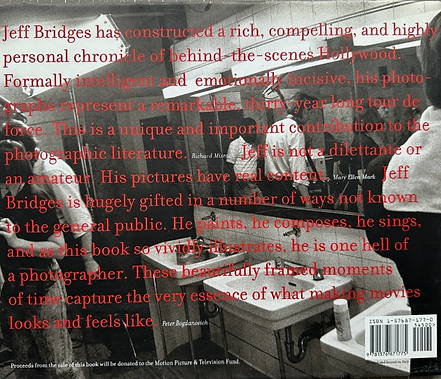
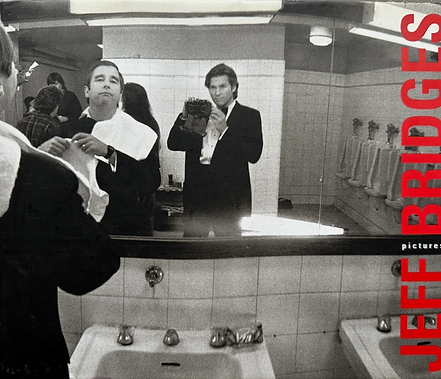
The cover of Pictures showcases a grainy wide black-and-white photo wrapping around the book. The image is natural and unposed, reflecting the documentary style of the work inside. In contrast, the bold, bright red typography stands out on the cover, spine, and back of the book, creating a strong visual impact. This contrast between the intimate photo and the eye-catching text highlights the dual nature of Bridges’ work, blending private moments with the very public film world. The cover invites viewers to explore the personal quality of the images, underneath the public performance, suggesting an immersive behind-the-scenes look at its subjects.
Subject Matter:
Jeff Bridges’ Pictures is a photobook documenting behind-the-scenes moments on Hollywood film sets, offering an intimate and personal perspective on the collaborative process of filmmaking.
Photography:
Bridges intention is to show the unseen Hollywood, with informal moments on film sets captured instead of typical polished images used to sell movies. Quiet moments, brief interactions, and collaboration among cast and crew are emphasised in his photographs, presenting filmmaking as a relatable experience rather than an inaccessible spectacle.
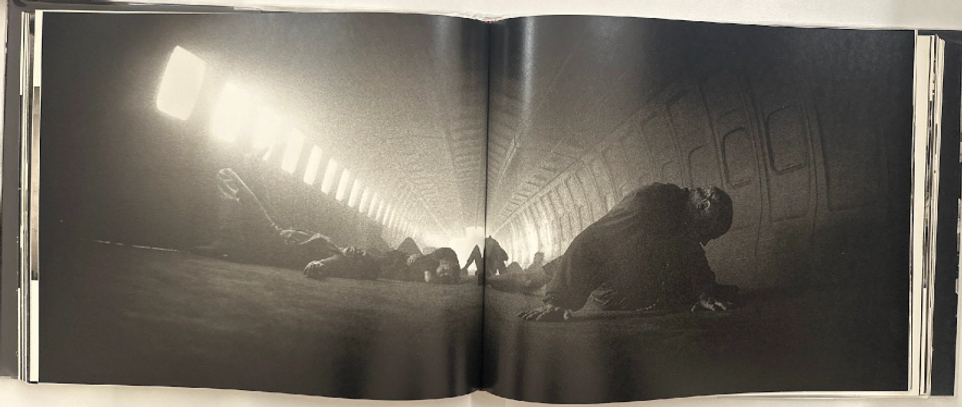
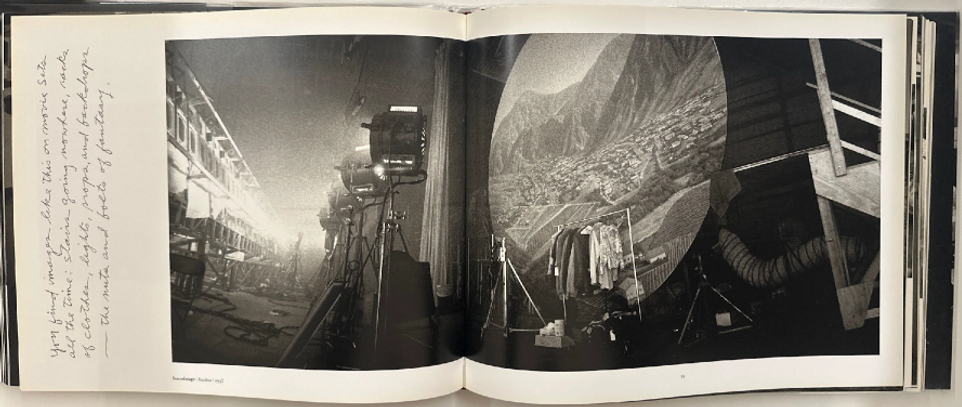
A candid documentary style is used, enhanced by his use of a Widelux panoramic camera. A sense of immediacy is conveyed by the slightly distorted wide frames, making viewers feel present in the moment. This approach effectively highlights both the grandeur of a set and the small, often overlooked personal moments.
Key images include group shots of actors in costume between takes, intimate scenes of crew members at work, and panoramic views of film sets that feel both grand and fleeting. Bridges’ role as both an insider and an observer of Hollywood is captured, showcasing its fascinating aspects while maintaining an authentic feel.
Page Layout:
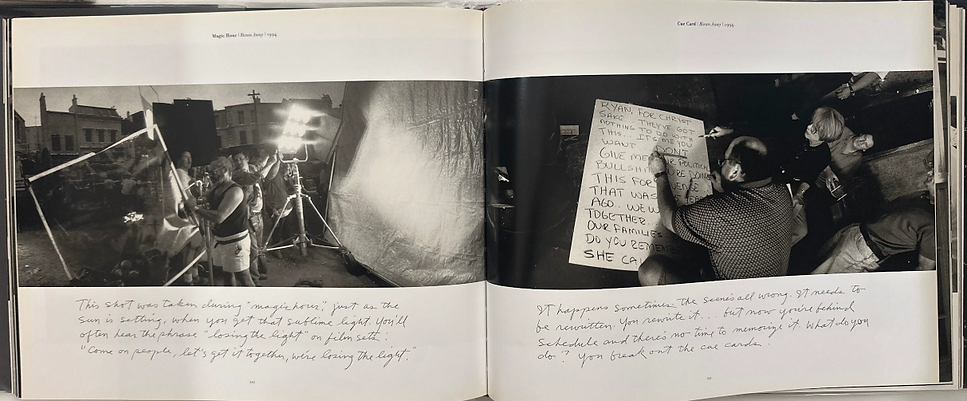
The page layouts in Pictures vary. They include: a panoramic photo on each side of the spread, a single full bleed image across the 3/4 of the spread, a single full bleed image across the entire spread, and sometimes even rotating the full bleed across the two pages, so it is a portrait panoramic photo, forcing the viewer to turn the entire book to see the image. The layouts do repeat, but don't seem to have a set pattern, which creates familiarity while also leaving room for curiosity.
Text
The placement of the captions is interesting, positioned at the top of the page, the bottom, or even on adjacent pages. A forward is included at the beginning of the book to introduce the work of Jeff Bridges (written by Peter Bogdanovich) as well as an introduction authored by Jeff Bridges himself.
Handwritten and typed commentary, filled with thoughts, details, and often humorous or personal experiences, is offered to guide readers, ensuring a nice balance between images and Bridges’ storytelling.
Editing & Sequencing
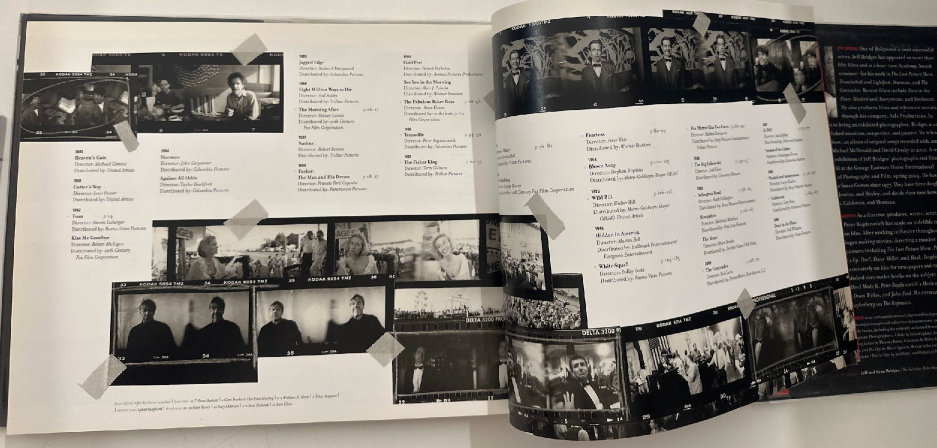
The sequencing of Pictures follows the chronological order of the films Bridges worked on.
Minimal cropping and intervention were applied, showcasing the Widelux panoramic frames as they were originally shot, wide and cinematic.
Bridges chose a few photos from each film section to capture the personalities, downtime, and atmosphere of the set. This resulted in a careful yet intimate curation.
Tone consistency was achieved by printing the images in rich black and white, ensuring a uniform visual language.
Overall Design
This book is large and heavy. Feel like a coffee table book.
The end pages are a red that matches the font on the outside cover.
An index titled "Filmography" is found in the back of the book, listing the movies in chronological order and connecting them to the corresponding photos within.
A colophon and acknowledgments are also included at the back of the book.
Influence on my work
Both Jeff Bridges’ Pictures and my own photobook treat image-making as a collaborative act. Bridges’ photographs are shaped by the intimacy of his relationships on set, where cast and crew become active participants in the creation of the images. Similarly, my work relies on collaboration with performers, both in the act of photographing and in the integration of their voices through quotes. In both cases, the aim is not simply to document, but to capture and communicate the feeling of being within that experience, whether that is the camaraderie of a film set or the shared world of a performance venue. Like Bridges, I wanted my book to feel inseparable from the environment it portrays: close, lived-in, and expressive of the collective spirit at its core.